
Why running a household feels like a second job (And what actually helps)


By: David Reich, Founder and CEO of Fambot · ~20 years building consumer technology at Uber, UnitedMasters and more
Published: 6.29.26
Last updated: 6.29.26
TL;DR: Running a household feels like a second job because the demands on parents are never ending: reading the updates, tracking the details, making decisions, and remembering what has to happen next. What helps is not another place to manually organize everything. Families need real support, fewer scattered inputs, and help they can ask for in the moment.
Why does running a household feel like a second job?
Running a household feels like a second job because modern family life requires constant operations work. Someone has to read the school email, notice the deadline, remember the birthday party, check the calendar, plan dinner, pack the camp bag, and make sure everyone knows what changed.
That work often happens in tiny pieces. Five minutes in the pickup line. Two minutes between meetings. Thirty seconds before bedtime when a parent remembers the permission slip. Or an hour or two on Sunday evening to plan the week ahead.
The U.S. Surgeon General has framed parental stress as a public health concern. According to 2023 data cited by HHS, 33% of parents reported high stress in the past month, compared with 20% of other adults, and 48% said most days their stress is completely overwhelming. Source
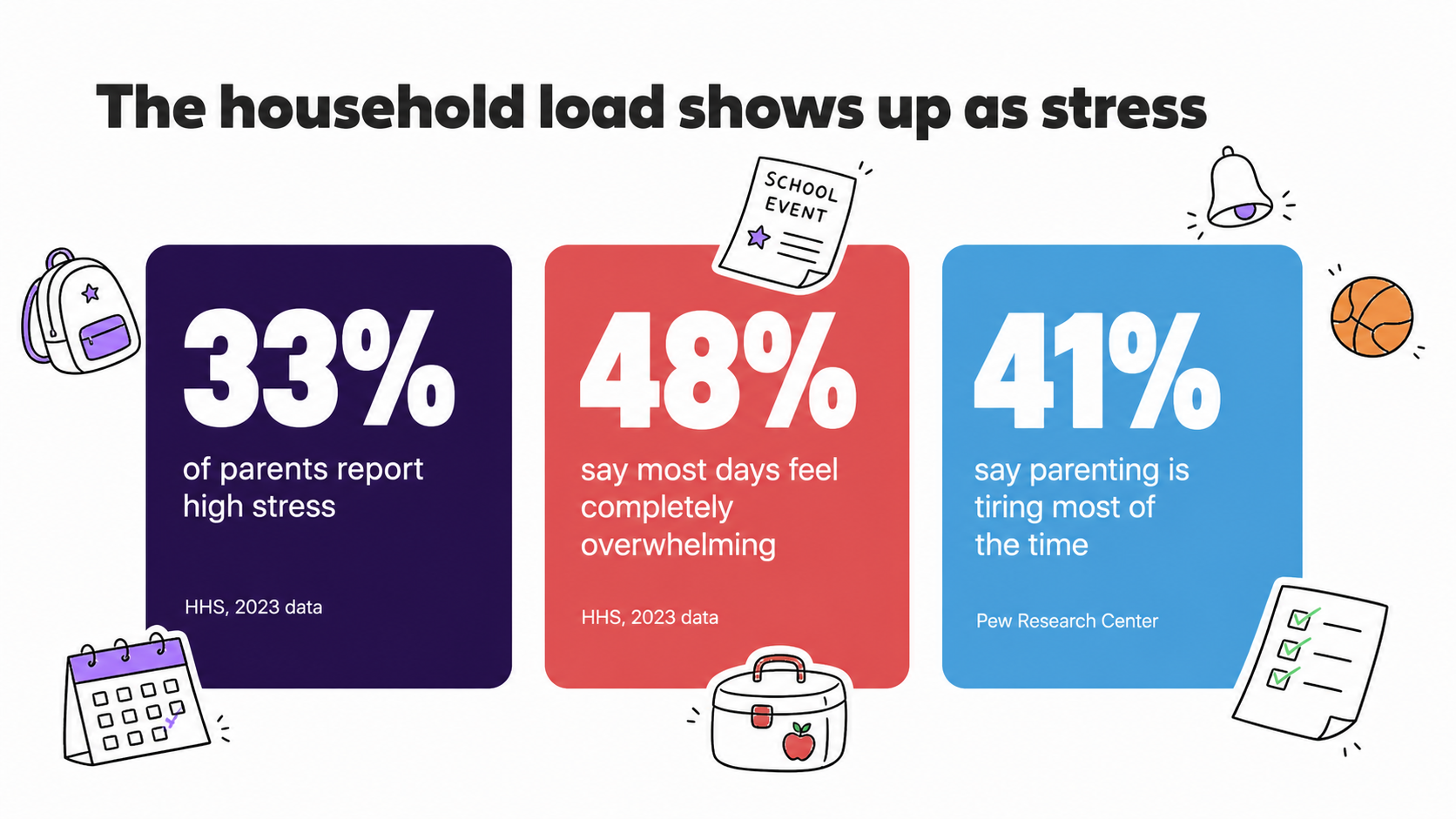
The phrase "second job" is not just a metaphor. The Surgeon General’s advisory says "the work of raising a child is just as valuable as the work performed in a paid job." Source
What is the household mental load?
The household mental load is the administrative work behind family life. It includes noticing what needs to happen, deciding what to do, remembering the timing, doing the thing or delegating it to your partner or child, and checking that the thing actually got done. It starts before anyone opens a calendar, packs a backpack, or drives to practice. Most parents start thinking about their non-work demands before they get out of bed in the morning.
Sociologist Allison Daminger defines cognitive household labor as four kinds of work: anticipating needs, identifying options, making decisions, and monitoring progress. Her 2019 study, based on interviews with 35 couples, found that women did more cognitive labor overall, especially anticipation and monitoring. Source
That explains why a parent can look "free" while their brain is running a full family control tower.
They are tracking the birthday RSVP, the dentist reschedule, the soccer snack rotation, the teacher gift, the pants that no longer fit, and whether the camp form was due yesterday or next Friday.
Why does running a family feel so draining?
Parents feel tired because finishing visible chores does not finish the household job. The dishes can be clean while the family plan is still full of open loops: who is driving, what is due, what needs to be bought, who replied, what changed, and what might be forgotten.
The Bureau of Labor Statistics found that in 2024, 80% of people spent 2 hours a day on household activities. Women were more likely than men to do household activities, 87% versus 74%, and women spent 2.7 hours on those activities on days they did them, compared with 2.3 hours for men. Source
Childcare adds another layer. In households with children under 6, women spent an hour more per day than men providing primary childcare, 3.0 hours compared with 2.0 hours. Source
And that still misses the planning layer. A time diary can capture bath time. It may not capture the parent who noticed the toothpaste was low, remembered their child decided tey hate mint flavored toothpaste, and put the new type on the right bathroom shelf.
Why is household management harder now?
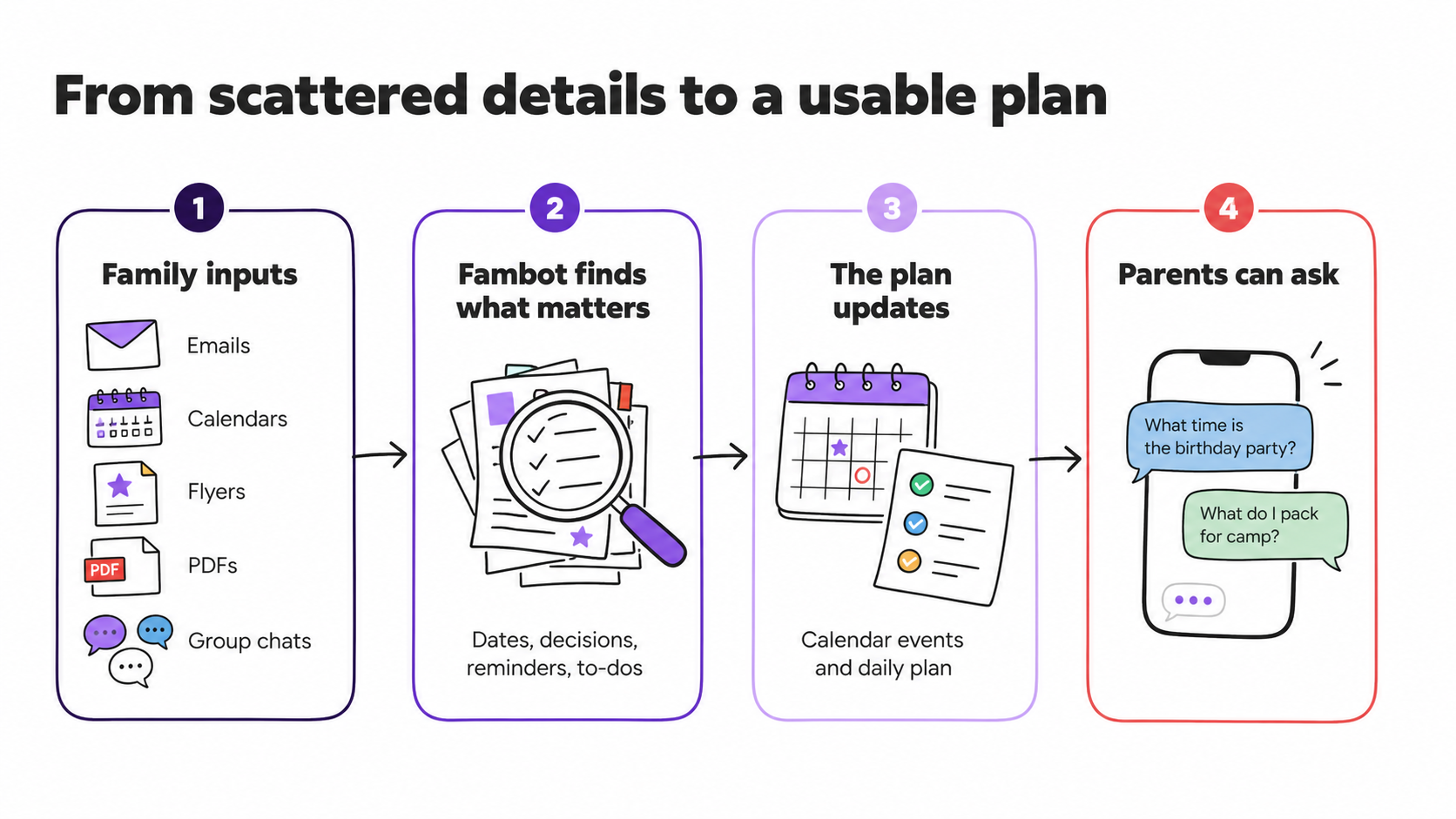
Household management is harder now because family information is scattered across more channels. School emails, calendars, newsletters, sports apps, group chats, PDFs, flyers, sign-up forms, birthday invites, and one-off texts all carry details a parent may need later.
The hard part is translation.
A school newsletter becomes four calendar events, multiple spirit day reminders, one payment deadline, and a mental note that Friday pickup will be messy. A camp email becomes a packing list, a drop-off time, a medication form, and a reminder to label the water bottle.
That is why many family tools fall short. A calendar stores what someone enters. A to-do app stores what someone remembers to write down. A shared note stores the list, if anyone opens it.
Fambot is built around the work parents are already doing: reading family information, deciding what matters, turning scattered details into a plan, and answering follow-up questions when life is moving fast.
What actually helps reduce the household mental load?
What helps is moving work out of one parent’s head and into a system the family can trust. The goal is not to become perfectly organized. The goal is to reduce remembering, retyping, checking, and last-minute scrambling.
Here is the practical difference between common fixes:
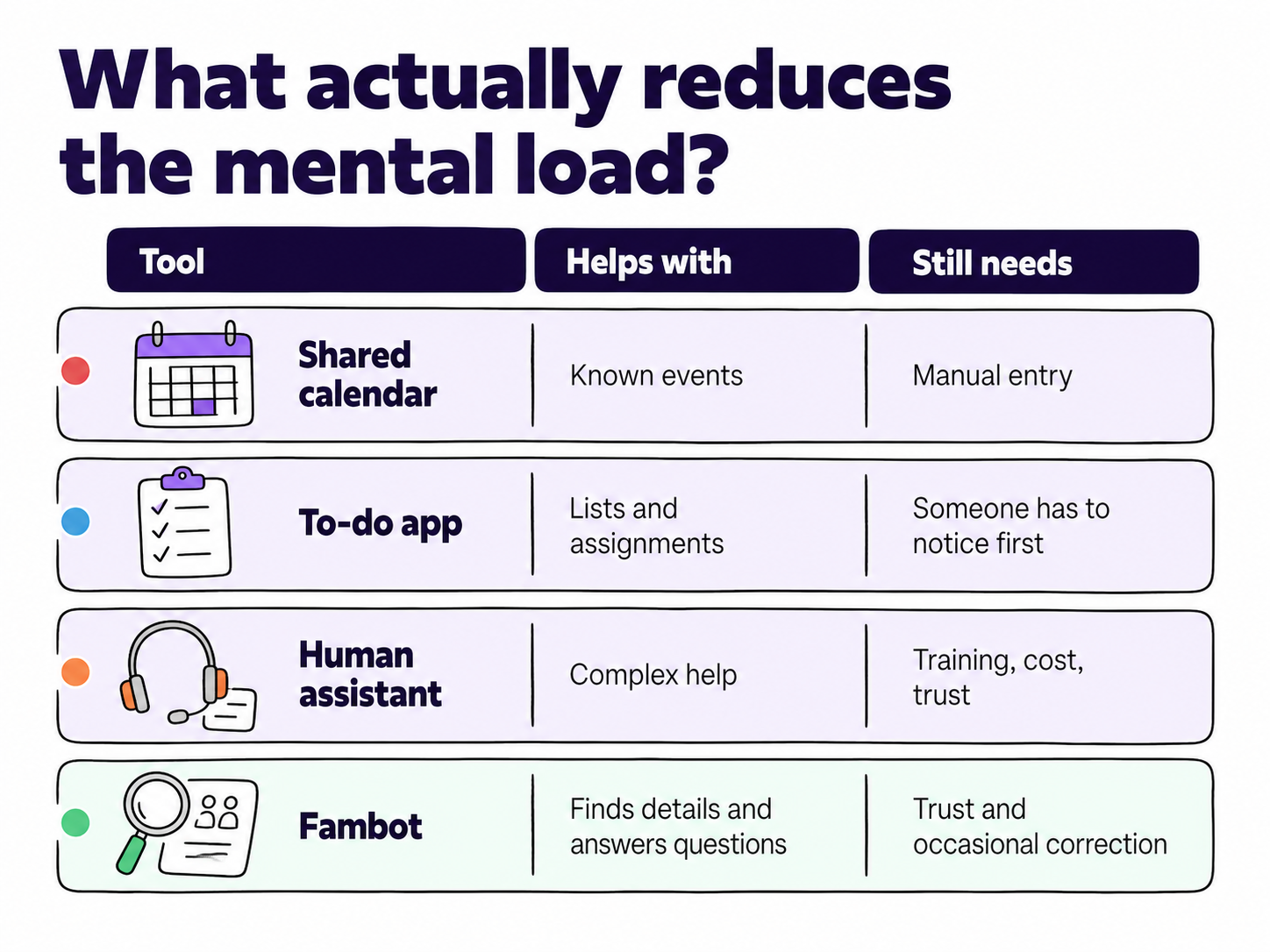
The best household systems have two traits. They capture information close to where it already lives, and they make it easy to get an answer without turning one parent into the family search engine.
Fambot works in that space. It connects to Gmail and/or Google calendars, identifies family-relevant information, pulls out dates and to-dos, adds key events to the family calendar, and sends a clear daily plan.
How does texting Fambot help parents in real life?
Texting Fambot helps because parents usually need answers while they are doing something else. Instead of searching email, opening the calendar, checking a group chat, and asking a partner, a parent can ask Fambot a direct question by text or in the app.
That matters in real family moments.
A parent is standing by the door with one shoe on, one child asking where the shin guards are, and another holding a flyer no one remembers reading. That is not the moment for a dashboard. That is the moment for a simple question: "What time is the birthday party?"
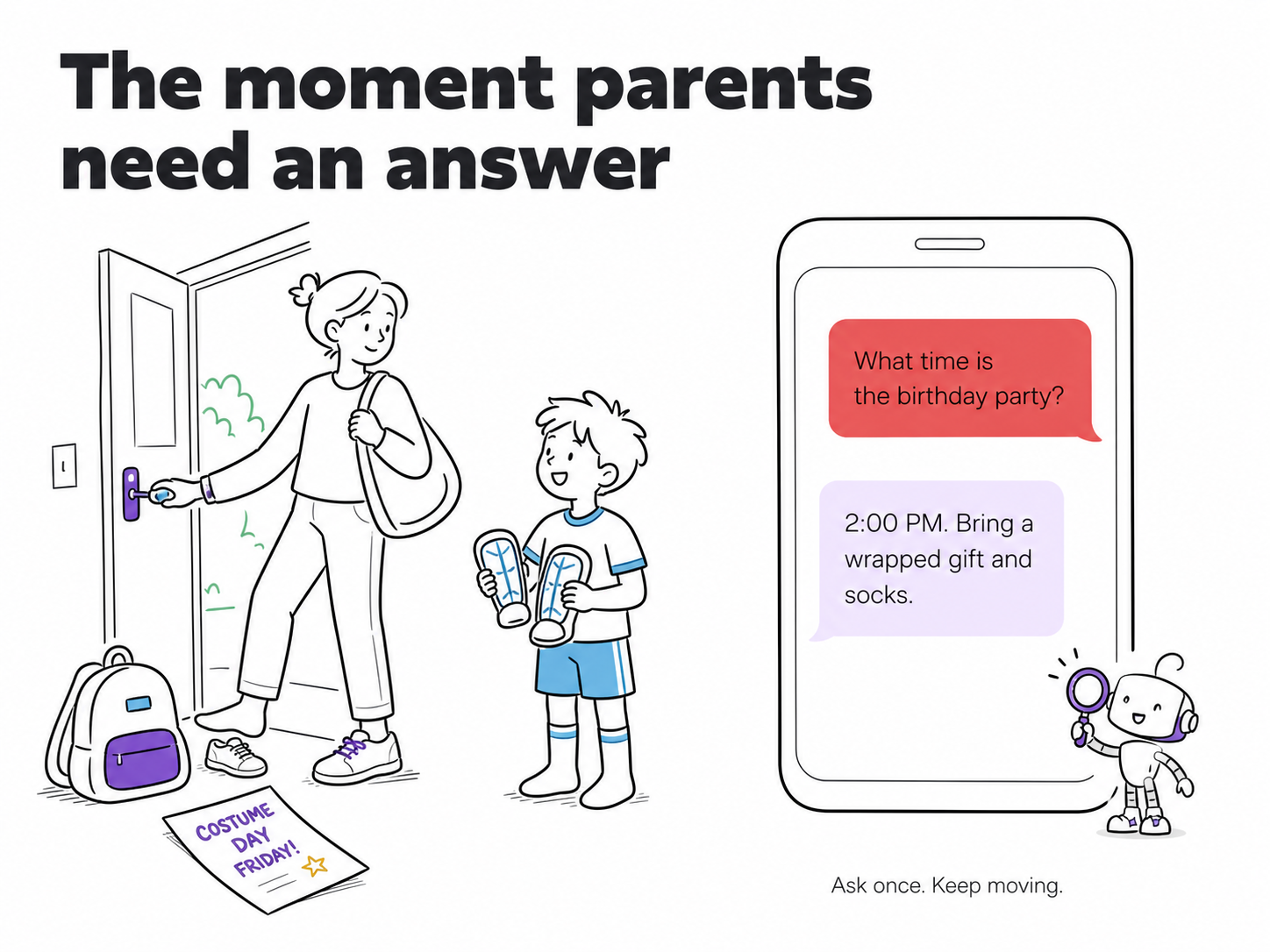
Parents can ask Fambot questions like:
This is where Fambot feels different from a family calendar. A calendar answers only if someone already entered the right information. Fambot helps find the information, from emails and the web, then turns it into a plan, and answers the question immediately when a parent needs it.
How can families share household work?
Families share household work more fairly when they assign full ownership, not just isolated tasks. "Can you help with soccer?" is vague. "You own soccer logistics this week: messages, timing, gear, snacks, rides, and updates" removes the manager role from the other parent.
This matters because partial delegation can create more work.
If one parent asks another parent to "handle the birthday gift," but still has to: share the email invite, choose the gift, send the link, remind them to order it, check delivery, wrap it, and put it by the door, the work was not really transferred.
A better household handoff includes:
Fambot can support that shift by making the plan more visible. When the key details are pulled into a daily plan and available by chat, fewer things depend on one parent’s private memory. Fambot also allows parents to assign tasks - so each parent knows who’s owning the to-do, and who’s doing pick up and drop-off.
Can technology actually help with household management?
Technology helps when it reduces input work. It does not help much when it gives families another empty box to maintain. The useful shift is from manual organization to proactive support: finding the details, extracting the action, adding it to the plan, and making it easy to ask follow-up questions.
That is the core difference - Fambot is proactive not reactive.
Fambot does not ask parents to become better data-entry clerks for their own families. It is designed to read the messy flow of family life, identify what matters, and make that information usable.
The difference is small on paper and huge at 7:18 a.m. A calendar waits for you to know what to add. Fambot helps find what you forgot to add, then lets you ask about it later.
Parents stop blaming themselves?
Parents should stop blaming themselves for being tired, scattered, or behind when the system around them is built on scattered information and invisible work. The problem is not that parents are failing at household management. The problem is that household management has become a real operations job without real operations support.
Pew Research Center found that 62% of U.S. parents say parenting has been harder than they expected, and 26% say it has been a lot harder. Pew also found that 41% of parents say parenting is tiring all or most of the time, and 29% say it is stressful all or most of the time. Source
So if running your home feels like a second job, it’s not an opinion it’s reality.
It means the family system is asking one brain to hold too much. The answer is not more guilt. It is fewer scattered inputs, clearer ownership, and help that catches the small things before they become big annoying things.
What is the simplest first step?
The simplest first step is to pick one recurring household category and stop treating it as a collection of random favors. Give it one owner, one source of truth, and one check-in rhythm. Start with school emails, sports logistics, meals, appointments, weekend planning, or camp prep.
For one week, write down every step in that category.
Not just "camp." Write the whole thing: read the email, find the dates, check the packing list, submit the form, add drop-off to the calendar, label the clothes, remember sunscreen, coordinate pickup, and tell the other parent what changed.
Once the work is visible, the family can decide what to delegate, automate, delete, or share.
That is the real unlock. You cannot fix what everyone keeps pretending is small.


